
A Panel Group Built Since the 1990s in Linyi, China
Dongstar Group dates its start to the 1990s in Linyi city, Shandong province, where it now runs four business areas under one brand: production, export trading, formwork systems and online sales. That gives an importer two checkable facts — a founding decade and an ownership structure — before a single price is discussed. All figures here are taken from the manufacturer's own pages, read 29 Sept 2026.

Key takeaways
- Founded in the 1990s in Linyi city, China; the gap from 1990 to 2026 is 36 years of trading history to question a supplier about.
- Four business areas operate under one brand, each with its own contracts, licences and bank details.
- Eight product lines are listed, running from film faced and commercial plywood to MDF, chipboard, melamine laminated plywood, WPC and formwork systems with accessories.
- Capacity, headcount and floor area are not published, so those numbers have to come from an audit rather than a directory.
Reading a founding decade as a business signal
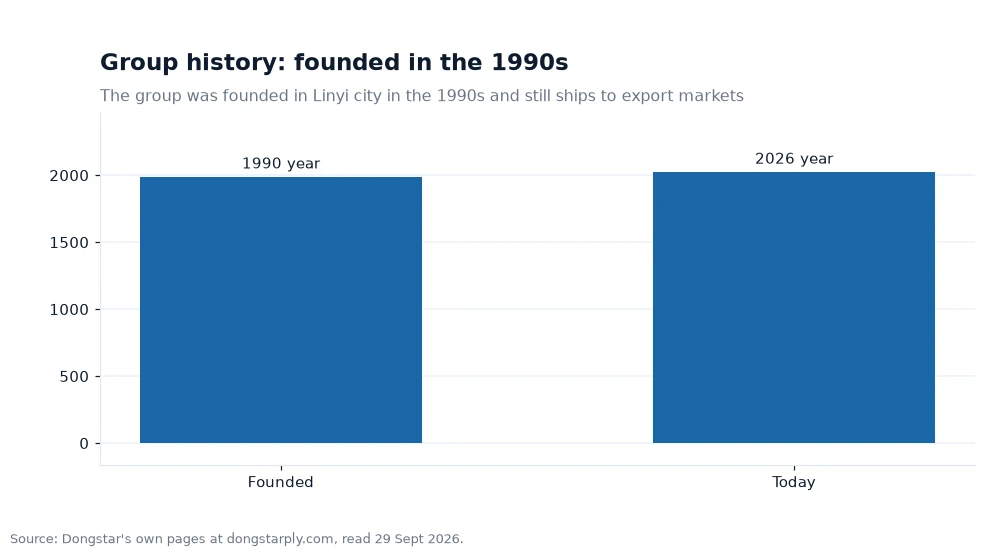
A start date in the 1990s is a claim that can be tested rather than admired. Dongstar Group states that it was established in Linyi city during that decade, which lets a buyer set the statement beside a business licence, an export licence and a shipping record. The chart further down this page puts the two ends of that story at 1990 and 2026, and the distance between those two numbers is the part that carries commercial weight.
Longevity changes what a quotation means in practice. A group that has shipped for three decades has already absorbed freight-rate spikes, tightening formaldehyde limits and several rounds of documentation change, and it normally has templates for that paperwork before the order exists. What an old founding date cannot supply is a capacity number. Output, headcount and floor area are not published, so a buyer who needs them should request them in writing or verify them on a plant visit instead of quoting a figure picked up from a trade directory.
Four business areas, and the paperwork each one owns
Behind the brand the group lists four business areas. Linyi Betterway Wood is described as the production arm; Linyi Dongstar Imp&exp covers export trading; Dongstar Formwork handles shuttering systems; and Dongstar E-Commerce sells online. The brand itself is written Dongstar®, and the operating company is named as Linyi Dongstar Import & Export Co., Ltd. Four trading names mean four sets of invoices and bank details, and a single commercial promise that has to be pinned to the right company.
This structure is ordinary in the panel trade and is not a warning sign by itself. The question worth sending by email is narrow: who signs the sales contract, who is named on the export licence, and who answers a quality claim once the container has been discharged? Get all three answers in writing early. If a pallet lands with a thickness drift or a crushed corner, the answer decides whether the claim goes to a trading desk in Linyi or to a factory gate further out of the city.
Linyi city: a panel cluster, not a trading address
Linyi sits in Shandong province, China, and has held one of the densest wood-based panel clusters in the country for decades. That matters to a buyer in a direct way: veneer, film, glue and presses sit within a short drive of each other, and the local workforce has grown up around panel machinery. It also means a city name on a website proves less than it appears to, because hundreds of suppliers share the same postcode.
The company's own description goes further than a postcode. It names a state-of-the-art production plant with advanced machinery and a large production capacity, and states that its quality control follows the panel from raw material selection to the finished board, using renewable and responsibly sourced material along the way. Read those as claims to be verified on site. An audit can test machinery, stacking practice, moisture handling and the traceability of incoming veneer in an afternoon, and it can settle the capacity question the website leaves open.
Eight lines listed under one brand
Eight product lines are listed under the brand: film faced plywood, commercial plywood and fancy plywood, together with MDF, chipboard, melamine laminated plywood, WPC and a formwork system with its accessories. Eight lines under one brand is normal for a group of this size in Linyi, and it is also where most sourcing confusion begins, because a single sales contact can quote products that are pressed on different lines, to different standards, with different lead times.
Suppliers that present themselves as Plywood Manufacturers normally publish entity names, base city and product lines before any price list, and the about page follows that order. Read it the same way: choose one line, ask for that line's specification sheet, and keep the other seven out of the negotiation until the first container has been delivered and inspected.
What a long history does not answer
A founding decade answers one question well — has this organisation traded through enough cycles to be trusted with a repeat order — and leaves the commercial ones open. It does not say which certificate covers which board, what thickness tolerance applies to a specific sheet, or what minimum order a mill will accept. Those three items live on product pages rather than on a company page, and they change from line to line.
The same page lists industry bodies the group works with, among them the China Shuttering Board Committee and the China Formwork and Scaffold Association, plus national standards work on plywood for concrete form and wood joists for building structures. Seats like that describe where a company sits inside its own industry. They are not a product certificate, so keep asking for the test reports and declarations that apply to the panel actually being bought.
| Item | What the page states | Why an importer checks it |
|---|---|---|
| Brand and operating entity | Dongstar®; Linyi Dongstar Import & Export Co., Ltd. | Decides who signs the contract and holds the export licence |
| Founding period | 1990s, in Linyi city, China | Sets the trading history standing behind a repeat order |
| Business areas | Linyi Betterway Wood (production); Linyi Dongstar Imp&exp (trading); Dongstar Formwork (systems); Dongstar E-Commerce (online) | Traces a claim to the right company instead of a brand name |
| Product lines | Eight listed, from film faced plywood to formwork systems and accessories | Keeps one specification inside each negotiation |
| Capacity data | Not published | Forces the figure to come from an audit or a written statement |
Worked example: dating the group against a purchase window
The chart below carries two values: 1990 for the founding year and 2026 for the present one. Subtract them and the group has 2026 − 1990 = 36 years of continuous operation (example arithmetic, using the page's own two figures). A buyer whose sourcing policy asks for at least twenty years of trading history can tick that box without asking for extra documents.
The same arithmetic works on an order. Take 1,000 sheets in the 1220 × 2440 mm format: 1.22 m × 2.44 m = 2.98 m² per sheet, so 1,000 sheets cover 1,000 × 2.98 = 2,980 m² of panel (example). Run the identical count in the 1250 × 2500 mm format: 1.25 m × 2.5 m = 3.125 m² per sheet, and 1,000 × 3.125 = 3,125 m² (example). The 145 m² gap is about 4.9% more panel area for the same sheet count, which is usually a wider spread than the discount gap between two competing quotations.
Frequently asked questions
Which entity should the contract be signed with?
The operating company is named as Linyi Dongstar Import & Export Co., Ltd., while production, formwork and online sales sit in the other three business areas. Ask for the contracting entity, the holder of the export licence and the contact for quality claims in writing before the proforma invoice is issued.
How much does a 1990s founding date tell a buyer?
It shows that the organisation has traded through several full market cycles, freight swings and regulatory changes. It says nothing about capacity, headcount or the tolerance held on a particular board, so those questions still need documents or a plant audit.
Why is the base city worth confirming?
Because Linyi city holds one of the densest panel clusters in China, so a great many suppliers share a postcode. Confirming the city, the plant address behind it and the entity that owns the plant is what turns a website claim into something an importer can visit.
Checking the group before the price list
Start with the entity, then move on to the panel lines the group actually presses, and finish with the formwork beam range if the project includes shuttering. A group that has been shipping since the 1990s has usually answered those three questions before an importer asks them, and the answers are what a first purchase order should be built on.
Entity names, the product line list and the founding period quoted above are documented on the manufacturer's own website, checked on 29 Sept 2026, and used throughout this guide[1].